

Common Insurance Mistakes to Avoid: A Complete Guide to Protecting Your Financial Future
Key Takeaways
✓ The most expensive insurance mistakes are the ones you do not discover until you need to file a claim
✓ Choosing the cheapest premium without understanding what it covers is the number one mistake families make
✓ Most coverage gaps are avoidable — they happen because people set their policies once and never review them
✓ Insurance is not a one-size-fits-all product — your coverage needs to match your actual life
✓ A 30-minute annual insurance review is one of the highest-value financial habits you can build
Insurance is one of those things that feels like it is working until the moment you discover it is not. By then it is too late to fix it. The mistakes that leave families financially exposed are rarely dramatic — they are quiet decisions made at enrollment time that nobody revisits until something goes wrong.
This guide covers the most common insurance mistakes James has seen over a decade of advising families in federally regulated insurance environments — and exactly how to avoid them.
Mistake 1: Choosing Coverage Based on Price Alone
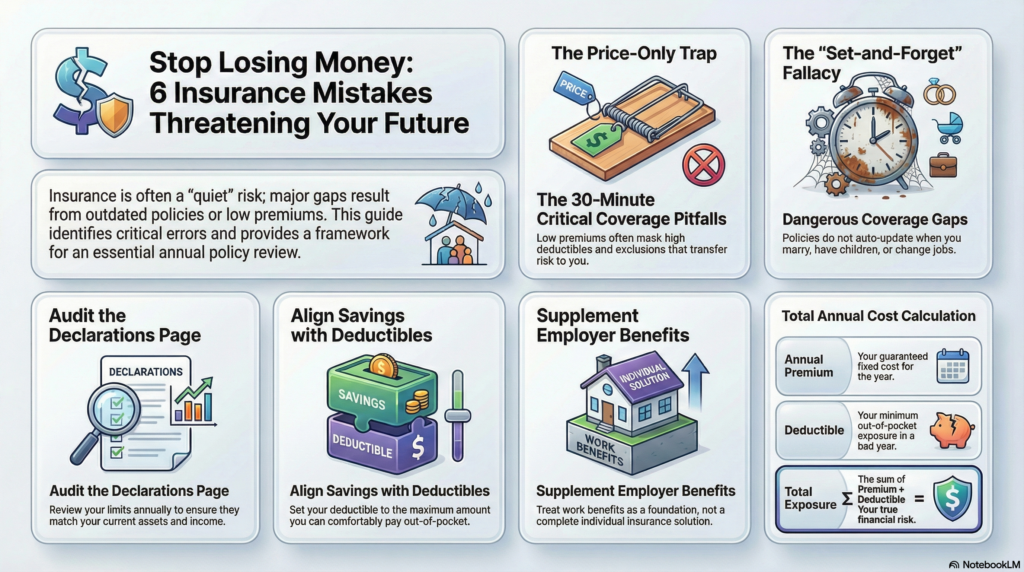
This is the most common and most costly mistake. A low monthly premium feels like a win until you realize it comes with a $6,000 deductible, a long list of exclusions, and coverage limits that would not survive a serious accident or illness.
Insurance is not like shopping for a TV where cheaper usually just means fewer features. Cheaper insurance often means you are transferring the financial risk back to yourself in less obvious ways. You discover the real cost when you file a claim.
How to Avoid It
Compare total annual cost, not just the monthly premium. Add your annual premium to your deductible. That is your minimum exposure in a bad year. Then check the coverage limits and exclusions. The right plan is the one that protects you best at a price you can sustain, not the one with the lowest sticker price.
Mistake 2: Never Reviewing Your Coverage
Life changes. Insurance does not update itself. The policy you bought three years ago was priced and structured around your life three years ago. If you have gotten married, had a child, bought a home, changed jobs, or paid off a car since then, your coverage needs have changed too.
Most families who discover they are under insured did not make a bad decision when they first bought the policy. They just never went back to review it as their lives evolved.
How to Avoid It
Put a recurring reminder in your phone every year at renewal time. Block 30 minutes to review your declarations page for every policy you carry. Ask yourself whether your coverage still reflects your current life. This one habit prevents the majority of coverage gap disasters.
Mistake 3: Relying Only on Employer-Provided Coverage
Employer benefits are a great starting point but they should never be your only coverage. Employer health plans rarely cover everything your family needs. Employer life insurance is almost always insufficient — typically one to two times your salary, which is far below what most financial advisors recommend.
The bigger problem is what happens when you leave that job. Employer coverage disappears with your employment. Families who relied solely on group plans often find themselves scrambling for individual coverage during a gap, sometimes at much higher rates or with pre-existing condition complications.
How to Avoid It
Use employer benefits as a foundation, not a complete solution. Supplement with an individual life insurance policy that travels with you regardless of employer. Review whether your employer health plan actually covers your family’s needs or whether a marketplace plan might serve you better.
Mistake 4: Not Reading the Exclusions
The exclusions section of any insurance policy is the most important section that most people never read. It lists everything the policy will not pay for. Coverage gaps almost always hide in the exclusions — and you only discover them when you file a claim and get denied.
Common exclusion surprises: flooding is excluded from standard homeowners policies. Wear and tear is excluded from almost every policy. Business use of a personal vehicle can void your auto coverage. Cosmetic procedures are excluded from health plans. None of these are hidden — they are written in the policy. They just rarely get read.
How to Avoid It
Before signing any new policy, read the exclusions section first. Ask your insurer or agent to explain any exclusion you do not understand. If a specific risk matters to you and it is excluded, ask whether a rider or endorsement can add that coverage.
Mistake 5: Carrying the Wrong Deductible for Your Financial Situation
A high deductible lowers your premium and feels like smart financial planning — until you actually need to use your insurance. If your deductible is $3,000 and you do not have $3,000 readily available, you are effectively uninsured for anything below that threshold.
On the other side, carrying a very low deductible when you have significant savings is also a mistake. You are paying extra every month to protect money you already have available. The right deductible is one that reflects your actual financial cushion.
How to Avoid It
Set your deductible at the maximum amount you could comfortably pay out of pocket within 30 days without financial strain. If your emergency fund has $2,000, your deductible should not exceed $2,000. As your savings grow, reassess whether a higher deductible and lower premium makes more sense.
Mistake 6: Skipping Coverage You “Probably Won’t Need”
Nobody buys flood insurance until their neighborhood floods. Nobody thinks about disability insurance until they cannot work. Nobody considers umbrella coverage until they face a lawsuit that exceeds their auto or homeowners limits. The coverage people skip is almost always the coverage they end up wishing they had.
Insurance exists precisely for the events that feel unlikely. Low-probability, high-consequence events are exactly what insurance is designed to protect against. Skipping coverage because something feels unlikely is the mindset that leaves families financially devastated by the exact events nobody plans for.
How to Avoid It
Ask yourself: if this event happened tomorrow, would I be financially okay without coverage? If the answer is no, you need to seriously evaluate whether that coverage is worth the premium. The question is not whether something is likely. The question is whether you could survive it financially if it happened.
James’s Take
“Every single mistake on this list is something I have seen play out in real families’ lives. The common thread is always the same — someone made a coverage decision based on incomplete information or never revisited a decision they made years ago. Insurance is not a set-it-and-forget-it product. Your coverage has to grow and change with your life. The families who do best financially are the ones who treat their annual insurance review as seriously as they treat their tax filing.”
James A. Sabb, Insurance Advisor and CEO, Sabb Media International LLC
Your Annual Insurance Review Checklist
Run through this checklist every year at renewal time. It takes 30 minutes and could save you thousands.
☐
Pull your declarations page for every active policy and read it
☐
Check that your coverage limits still match your current assets and income
☐
Verify your beneficiaries are up to date on all life insurance policies
☐
Ask your insurer about any new discounts you may now qualify for
☐
Get at least one competing quote for your auto and homeowners coverage
☐
Check whether your deductible still makes sense given your current savings
☐
Identify any major life changes since last review that should trigger a coverage update
Frequently Asked Questions
What is the most expensive insurance mistake a family can make?
Going without adequate health insurance is consistently the most financially devastating mistake. A single serious illness or hospitalization without proper coverage can result in tens or even hundreds of thousands of dollars in medical debt that takes years to recover from.
How do I know if I am under insured?
Ask yourself this: if the worst realistic scenario happened today, would your coverage be enough to keep your family financially stable? If you hesitate, you are likely under insured in at least one area. An insurance agent or independent broker can do a coverage gap analysis for free in most cases.
Can I fix coverage gaps on an existing policy?
Often yes. Many gaps can be addressed mid-policy by adding a rider or endorsement, increasing your coverage limits, or purchasing a supplemental policy. Contact your insurer directly to discuss what options are available without waiting for renewal.
Is it a mistake to file small insurance claims?
Sometimes. Filing a claim for a minor loss can trigger a rate increase that costs more over time than the claim itself was worth. As a general rule, if the repair or replacement cost is less than twice your deductible, consider paying out of pocket to protect your claims history and keep your premium stable.
What should I do if I discover a coverage gap right now?
Contact your insurer or an independent broker immediately. Do not wait for renewal. Explain the gap you identified and ask what the fastest way to address it is. Most coverage additions can be made effective within days. The longer you wait with a known gap, the more financial risk you are accepting.
Continue Learning
→Insurance and Risk Management: The Complete Guide for Families
→How to Choose the Right Insurance Policy: A Step-by-Step Guide
→Understanding Insurance Premiums: What You Pay and Why
→What Does Insurance Actually Cover? The Complete Guide
Want to Keep Learning?
Explore plain-language guides on insurance, financial planning, investing, and consumer protection, all in one place.
Everything on SabbMedia.com is written and reviewed by James A. Sabb, a consultant with over 30 years of experience in regulated industries.
Written and Reviewed by James A. Sabb
Consultant and Advisor · 30+ Years Experience · Health Insurance Advisory Since 2015 · CEO, Sabb Media International LLC · Pompano Beach, FL
James A. Sabb has spent over three decades in regulated industries, including 10 plus years advising individuals and families on insurance decisions within federally regulated environments. He founded SabbMedia.com to bring that inside expertise to everyday people. No sales pressure, no jargon, just clarity.
Disclaimer: The content on this page is intended for educational and informational purposes only. It does not constitute financial, legal, or insurance advice. Sabb Media International LLC is not a licensed financial advisor or insurance broker. James A. Sabb provides consultative and educational guidance only. Always consult a qualified, licensed professional before making any financial or insurance decisions.